ClearView Active HUD
Transform your windshield into a dynamic, fog-free navigation and safety interface.
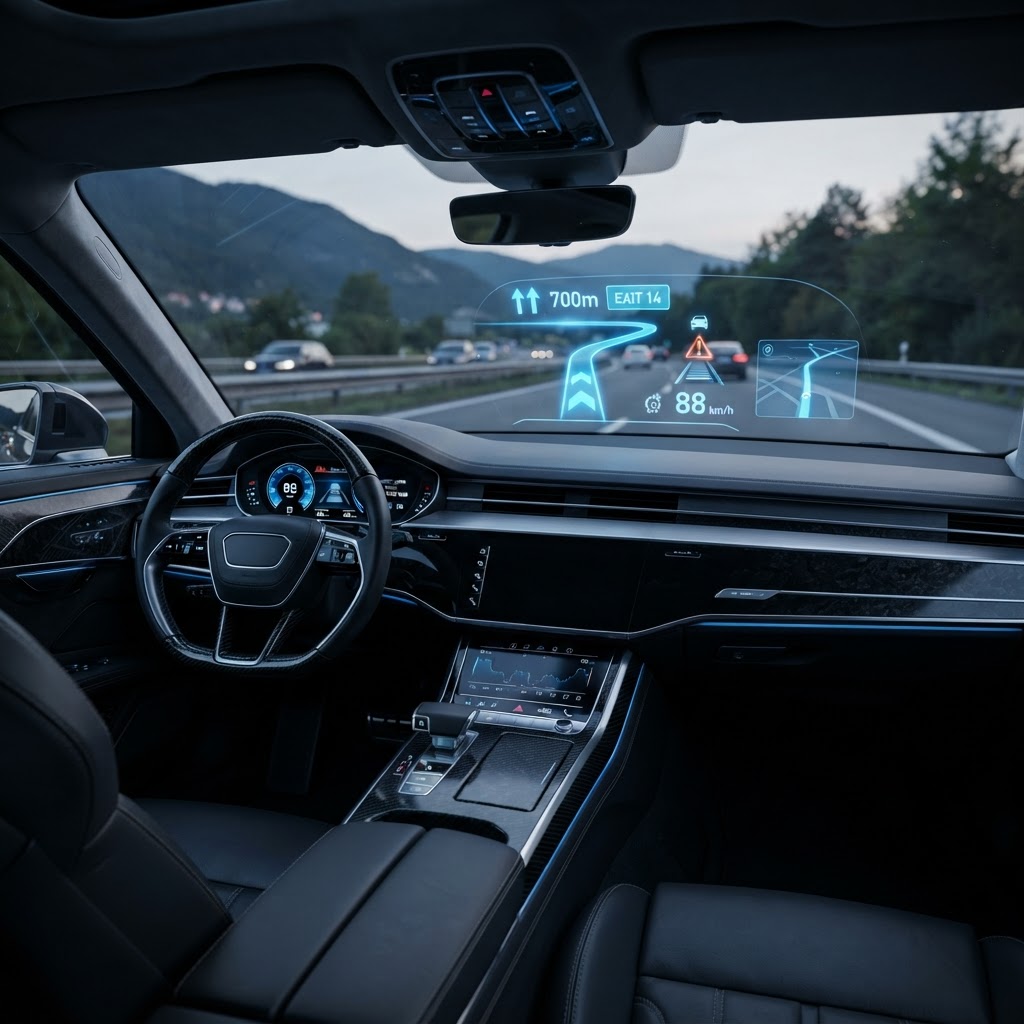

Overview
ClearView is an integrated windshield overlay system designed to eliminate fog, glare, and blind spots while providing real-time AR navigation overlays directly onto the glass.
Key Components
- Graphene Heating Element: A transparent, nanometer-thin graphene film embedded in the glass that provides rapid, uniform de-fogging without obscuring vision.
- Micro-LED Projection Array: A thin-film projector housed in the dashboard that utilizes micro-mirrors to beam high-contrast AR graphics onto the windshield.
- LiDAR Sensor Suite: External sensors that map road conditions and hazards, feeding data to the AR engine.
- Smart Tinting Layer: An electrochromic polymer film that automatically adjusts opacity to block blinding sun glare.
How It Works
- Sensors detect environmental conditions like ambient temperature, humidity, and incoming light intensity.
- The graphene film activates upon detection of moisture to prevent condensation instantly.
- The electrochromic layer darkens in high-glare conditions to protect the driver's vision.
- The micro-LED system projects turn-by-turn navigation and hazard alerts onto the windshield, synced with the driver's gaze tracking.
Materials & Construction
The system is constructed as a sandwich of tempered automotive glass, bonded with a layer of graphene-coated polymer. The housing is precision-milled aerospace-grade aluminum, utilizing a heat-sink design to dissipate energy from the projection system.
The device leverages the unique thermal and conductive properties of graphene. By applying a low-voltage current to the single-atom-thick graphene grid, the windshield acts as a resistive heating element that radiates uniform heat, preventing the dew point from being reached on the glass surface. The AR projection uses a 'holographic optical element' (HOE) embedded in the laminate, which reflects specific wavelengths of light from the micro-LED projector while remaining transparent to the visible spectrum of the road. Electrochromic technology is achieved through a thin-film deposition of tungsten oxide, which changes its light absorption properties when a small voltage is applied, effectively acting as an active polarized filter.

